OpenEMR: The Complete Guide to the World’s Most Popular Open-Source EHR
A practical guide to the world's most popular open-source EHR, its architecture, FHIR APIs, Docker setup, and where it can fit well.
February 25, 2025
Have you struggled with sharing your medical information between hospital visits? openEHR might hold the answers to healthcare’s ongoing struggle with data reusability.
The healthcare industry presents unique challenges when it comes to data modelling—new information, details and relationships are constantly being discovered. This means that an information system built in conventional approaches - where both information and knowledge, or data and clinical information about the data are built into a single data model quickly becomes obsolete.
openEHR is designed keeping this in mind—understanding that the domain of medical information is a changing place, and that changes to requirements aren’t exceptional. In openEHR, information and knowledge are separated into two layers,
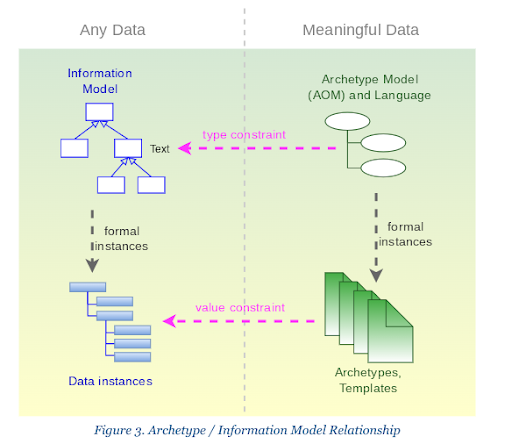
A helpful analogy is to think of it as a library, the information level are the shelves that provide structure and the knowledge level are the books, the collection of which can change and grow over time. In openEHR, the reference model (RM) defines a stable way to store patient data, and the knowledge level or archetype model (AM) defines medical concepts that give the data meaning. The knowledge level in openEHR consists of archetypes and templates that we will now explore in detail.
An openEHR Archetype is a reusable, domain-specific building block that structures clinical data. They define content on the basis of topic or theme e.g. blood pressure, physical examination, report. These are designed by domain experts or clinicians and are vendor neutral.
Archetypes have a machine readable GUID that is assigned to it when it is created. They also have Human Readable IDs (HRIDs) as represented in the below example.

The openEHR Clinical Knowledge Manager(CKM) is a health data management application and repository of clinical concepts developed with the goal to create a coherent health data ecosystem that promotes sharing and reusing of clinical concepts across multiple clinical scenarios.
Here is a blog that explores this further.
Using the CKM, let’s explore what an Archetype looks like, with the example of a blood pressure archetype that is accessible as the Blood Pressure Archetype (v2) with HRID org.openehr::openEHR-EHR-OBSERVATION.blood_pressure.v2
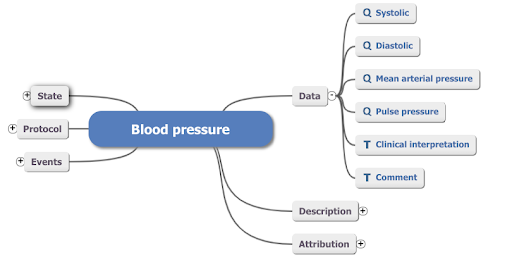
The blood pressure Archetype defines the data and other contextual information about a blood pressure reading. This structured approach enables consistency in health data capture and storage and therefore ensures reusability.
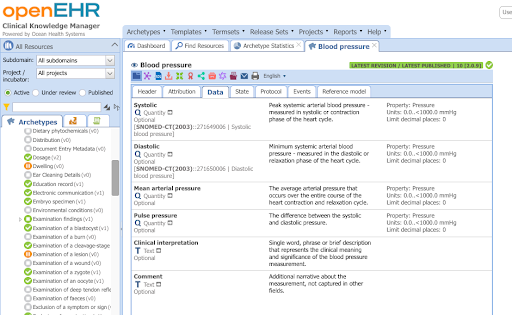
It defines the kind of data that can be captured, including systolic, diastolic, mean arterial pressure, pulse pressure, and clinical interpretations and comments. You can also look at the mind map representation to visually understand the structure of an archetype.
An openEHR Template allows the use of Archetypes for specific clinical scenarios such as a patient admission or discharge. They are usually customized for practical use in a particular healthcare setting and are the “real-world” versions of the Archetype. It caters to the actual clinical workflow and usually corresponds to clinical forms, even indicating which information is mandatory and optional.
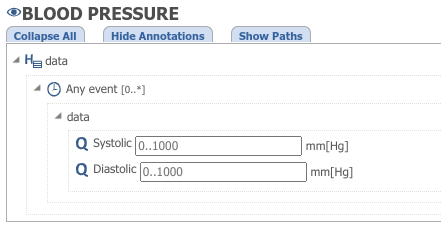
For example, a blood pressure measurement template might use only the systolic and diastolic fields from the archetype, ignoring the ‘mean arterial pressure’ if it is not a priority. It could also make some fields mandatory such as the patient position field or method of measurement (manual/automatic).
The blood pressure template blood pressure template, for example, only includes systolic and diastolic values and excludes other data points.
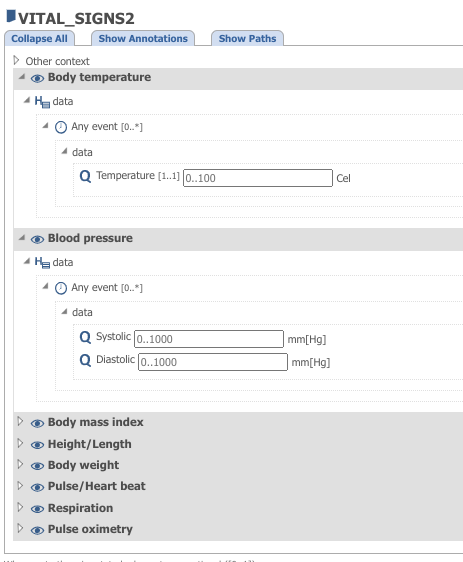
This Vital Signs template uses the blood pressure archetype and other archetypes including body temperature, height, weight etc. to capture the most commonly used patient information.
To go ahead and create your own openEHR Template, you can follow this tutorial. You can also check out the follow up blog, Designing openEHR Templates using the Archetype Designer to get started with making your own templates.
openEHR’s two-level methodology of information system design results in several benefits,
openEHR’s two-level data model is a powerful approach towards modernizing healthcare data management. It provides a standard data foundation for clinical concepts through Archetypes, and flexibility in their implementation through Templates. This ensures both semantically clear and reusable healthcare data that is interoperable, and adaptability in implementation.
In a world where accessing the right data at the right time is essential to improving patient health outcomes, openEHR is a timely solution to address fragmented healthcare data challenges. The key features of interoperability, flexibility, improved data quality and future proofing are critical towards building a scalable and sustainable foundation for the future of healthcare innovation.
Enroll in the free openEHR Fundamentals Course to learn more about openEHR, the open clinical data standard that’s transforming the healthcare data landscape. Register now!
A practical guide to the world's most popular open-source EHR, its architecture, FHIR APIs, Docker setup, and where it can fit well.
This project breakdown looks at how we built Tip2Toe, a rare disease phenotyping application for Karolinska University Hospital.
Why openEHR works better as a silver layer in your data warehouse than as a CDR, and what that means for clinical data at scale.
No comments yet. Be the first to comment!