Healthcare Has A Sync Problem
Healthcare interoperability keeps failing for the same two reasons: inconsistent data models and bad sync. Here's what solving both would actually take.
November 27, 2026
Most healthcare data teams I’ve seen could fit in one room. I’ve seen huge organizations with two people running their entire data ops. But the demands on their data keep growing.
Nobody in healthcare is questioning whether data matters anymore. Payers want to use it to optimize costs. Providers want to use it for better outcomes and better care. Everyone is talking about putting AI on top of it. So it’s established that the data across a healthcare enterprise needs to be visible to the people who act on it.
What isn’t settled is how to get there. A lot of people in healthcare don’t even know the techniques being used outside healthcare, and I think it’s because the default in healthcare is to look for something healthcare-specific.
There’s a good article on this called “Escaping the EHR Trap” by Kenneth Mandl and Isaac Kohane, and I’d recommend it to anyone working in healthcare. The argument is that healthcare always goes and buys specialized systems. We can’t just buy something off the shelf and use it. A specialized EHR is fine. But even for things like inventory management and invoicing, we buy software built for healthcare, because we assume healthcare needs something special.
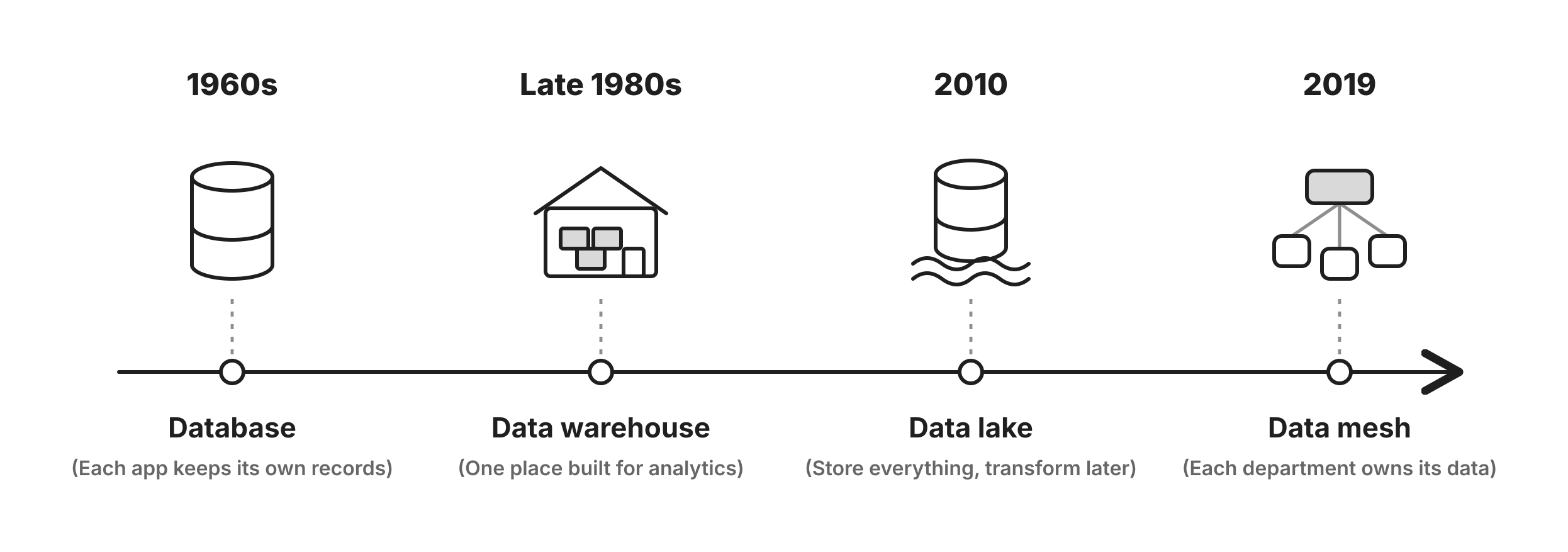
For analyzing data, the techniques are pretty much the same inside and outside healthcare. So, I want to walk you through how data architecture evolved, from querying your database directly all the way up to the data mesh, and where I think healthcare should stop.
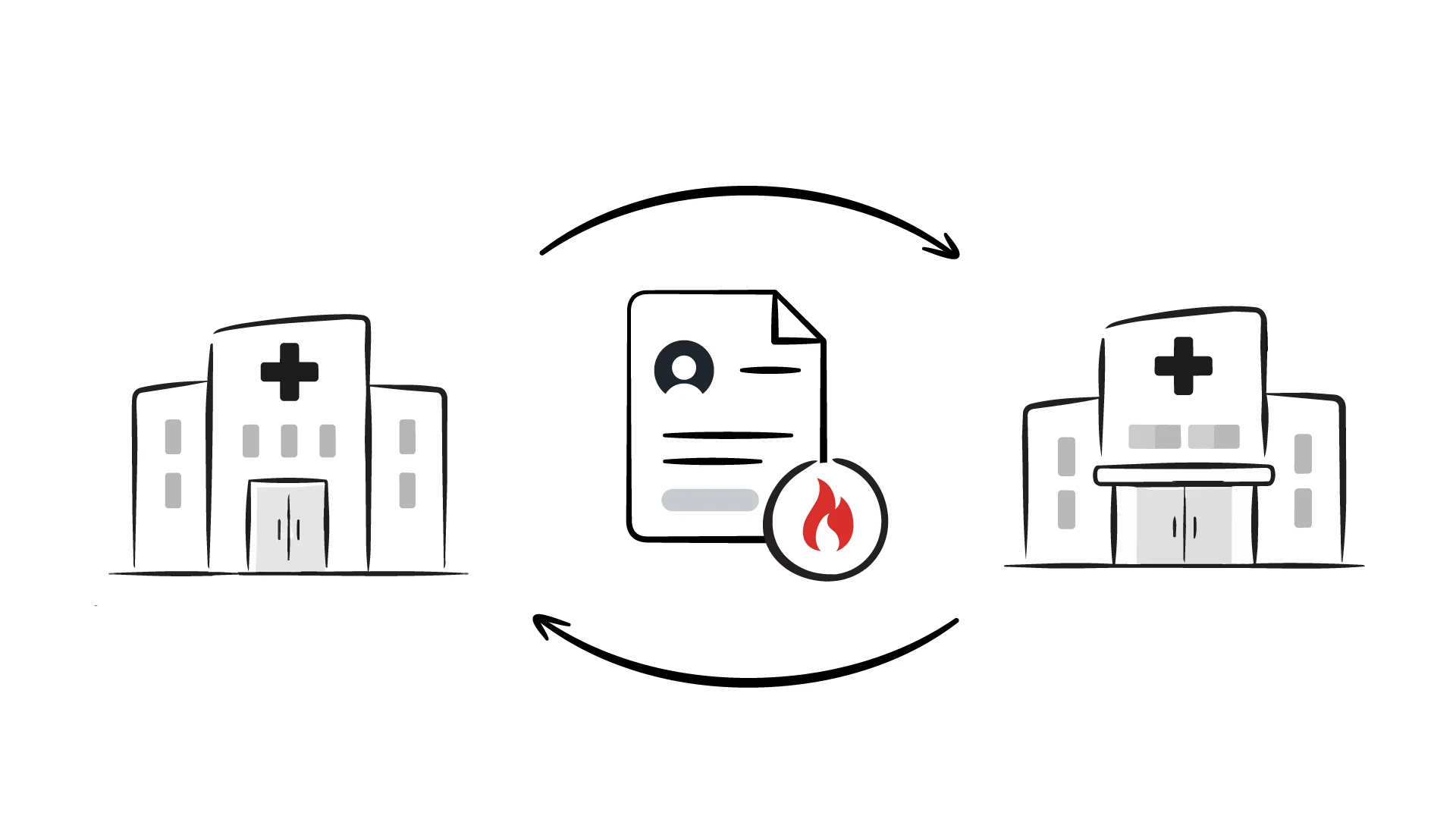
Your EHR runs on a database. So does your laboratory information system (LIS), your radiology information system (RIS), your hospital management information system (HMIS), and every other “IS” in your enterprise.
These almost always run on an OLTP system (Online Transaction Processing), like MySQL, Postgres or Oracle. OLTP databases are optimized for recording what happens. In a hospital, a transaction is something like registering a patient, placing a lab order, recording a blood pressure reading or updating a prescription. Each one touches a single patient’s record, and they happen all day.
The opposite is OLAP (Online Analytical Processing), which is optimized for analyzing what’s been recorded. Instead of one patient at a time, it looks across many patients at once, to answer questions about trends, totals and patterns. In a hospital, you’d use it to ask how many admissions there were last month, or which departments have the longest wait times.
The clearest way to see the difference is to ask both about the same thing, let’s say, a diagnosis.
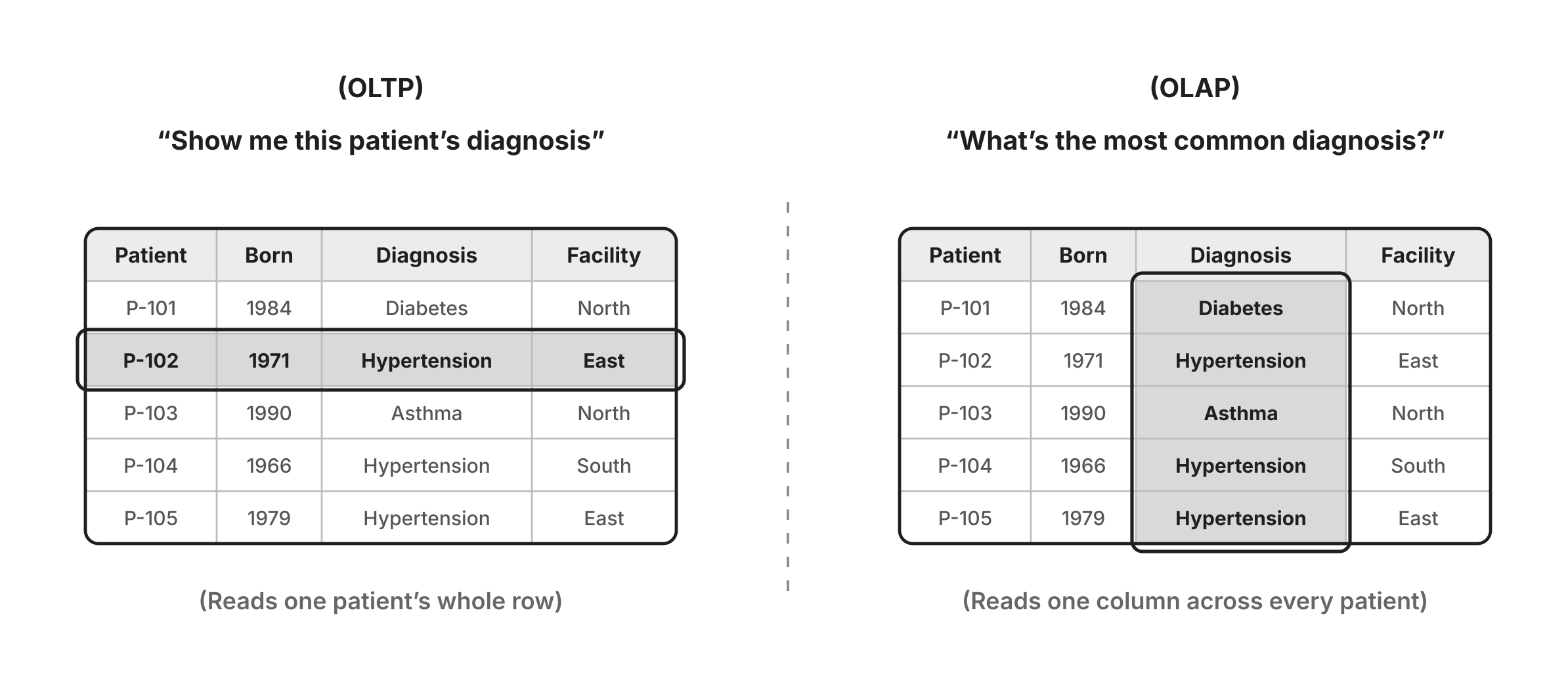
These two queries need quite different machines. An OLTP database stores data row by row, so pulling up one patient’s whole record is quick. But to find the most common diagnosis, it has to read every patient’s full row just to get at one field. An OLAP database stores each column together, so it can read only the diagnosis column and skip the rest.
Even so, most healthcare organizations run their analytics straight on the OLTP database. As far as I’ve seen, it’s still the most common approach. It works, but it isn’t what the database was built for. And every system has its own OLTP database, so the data you want to analyze is spread across all of them. That’s why separate systems evolved for analytics, starting with the data warehouse.
You have the EHR, the LIS, the RIS, the HMIS and a bunch of other systems. Wouldn’t it be nice if you could move all the data you want to analyze into one single place that’s optimized for analytics?
That’s the idea behind the data warehouse. It’s associated with Bill Inmon and Ralph Kimball, among others, and took off in the 1990s.
The warehouse itself is usually an OLAP system. ClickHouse is a good example, and there are cloud products like Redshift. But you could also use a regular OLTP database. Plenty of people use Microsoft SQL Server as their warehouse, and that’s fine too, at a smaller scale.
Data gets into the warehouse through ETL (extract, transform, load). You have a bunch of jobs, usually running nightly, that extract the important information from each system, transform it, and load it into the warehouse. The transform step is where most of the work happens. The EHR and the lab system might use different patient IDs, different codes for the same test or different units, and the job has to reconcile all of that before the data lands. Then your analysts run their queries there.
Once the data is in the warehouse, it’s also modeled differently. An OLTP system uses a normal form, like third normal form (3NF), to avoid data anomalies. That way, every fact is stored once, so when a patient’s address changes, you update it in one place. A warehouse is optimized for query performance instead, so you denormalize the data, repeating some information on purpose so a query doesn’t have to piece it together from separate tables. The result is what’s called a dimensional model.
Say you have a table of diagnoses, where each row points to who the patient was, when it happened and which facility it was at. “Most common diagnosis by facility last quarter” becomes a simple query to run.
There are whole textbooks on this. The go-to is The Data Warehouse Toolkit by Ralph Kimball and Margy Ross.
The limiting factor was the ETL. People didn’t know upfront what to extract from the OLTP systems, and different data points mattered to different people. Every time the requirements or the dimensional model changed, the data engineering team had to rewrite the ETL script and all the reconciliation logic inside it, delete the table from the warehouse, refresh it from the source systems and rerun everything. With the logic spread across separate scripts, it was hard to see where any piece of data had come from. All of it took a lot of time.
Healthcare has its own version of the data warehouse, using FHIR servers and openEHR clinical data repositories (CDRs). Teams push data from every system into one, treat it as the source of truth, and have analysts work off it. There’s nothing wrong with that as such. But it has the same problem. Most of the effort goes into maintaining the scripts, and every time a source system changes, the output changes and the analyst needs to know about it. I’ve written about this before in The data warehouse is openEHR’s strongest use case right now.
With a warehouse, you only moved the data you’d really analyze, because storage was expensive and every extra table added to the bill.
The data lake came out of an engineering unlock that separated storage from compute. In a traditional warehouse, the same machines store the data and run the queries, so keeping more data means paying for more of those machines, whether or not anyone uses it. In a data lake, the data sits in cheap storage, and the computing power is only switched on when someone runs a query.
Storage had also become a commodity. Keeping data on something like Amazon S3 is so cheap today that it’s not even something people think about. It only gets expensive if you’re storing terabytes of imaging data like DICOM. For structured data, the tables and columns we’re talking about here, the cost isn’t really a concern.
So companies like Snowflake and Databricks built on this. Their pitch was that storage is cheap and compute is what matters, so why choose what to store at all? Dump everything into something like an S3 bucket. It doesn’t matter what it looks like, because you can process it later.
Snowflake itself is technically a cloud warehouse, and cloud warehouses like Snowflake and BigQuery separate storage and compute the same way. That’s why the line between a warehouse and a lake has blurred.
Dumping everything first and processing it later also flips the order of ETL. It becomes ELT. Instead of transforming the data on the way out of the database, you extract it and load it as is, and the transformation happens later, inside the lake, when someone actually needs it. BigQuery, Microsoft Fabric, and almost every big data product you’ve heard of work on this principle today.
This is where the medallion architecture (a data design pattern popularized by Databricks) comes in. Data as it’s first loaded is called bronze. As you clean it up, it becomes silver. When it’s organized into data marts, tables built for a specific team or question, it’s gold. All of this happens as SQL or Python transforms running inside the lake. And the modeling hasn’t changed much. The gold layer is usually still a dimensional model.
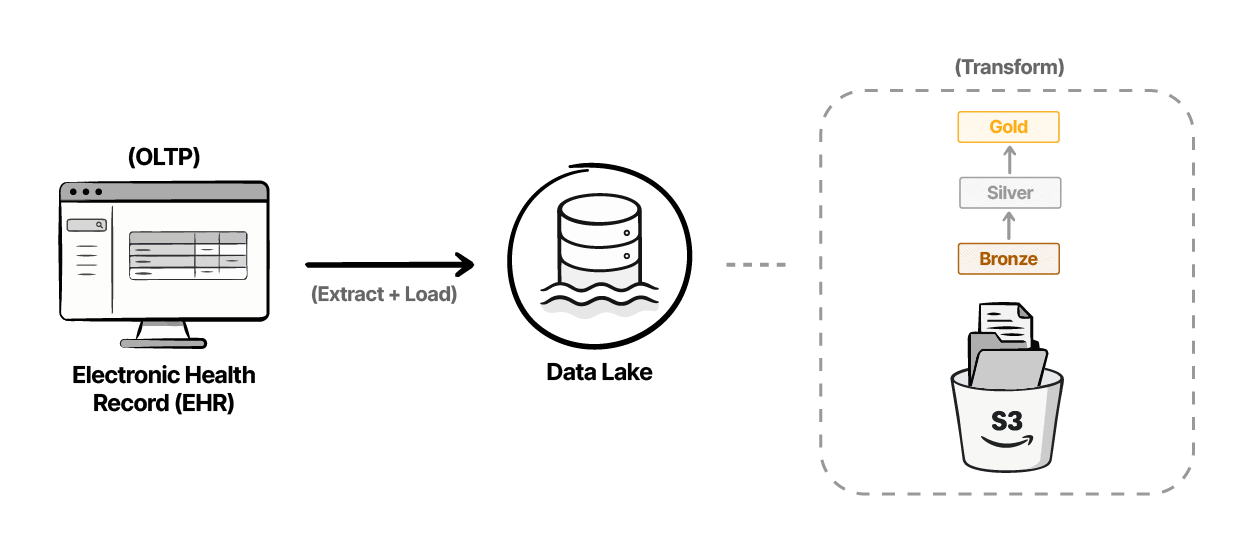
When the transforms run inside the lake, lineage comes almost for free. Lineage is a record of where every piece of data came from and what was done to it along the way.
Take dbt, an open source tool for running data transforms that works with most warehouses. Each transform, called a model, is just a query on other tables. When you run it, dbt creates a view by default (a saved query instead of a copy of the data), and that view depends on the tables it reads from.
Because every model is a query on other tables, dbt always knows where its data came from. Say you have an admissions model built from the EHR’s encounters table and the patient table. dbt can tell you it depends on those two sources, however complicated the query gets. It also draws those dependencies as a graph, so when a source table changes, you can see everything downstream of it.
Lineage tracking became a big deal because data governance was getting more attention around the same time. People wanted to know how fresh the data was, whether they could trust it, and whether it passed quality checks. So a bunch of tools started providing something called a data catalog.
A data catalog sits on top of your data. It holds none of the data itself, only metadata (information about the data), such as who owns a dataset, who’s taking care of it and what its lineage is. It’s how people in your organization find out what’s available in your warehouse or lake. Tools like DataHub and OpenMetadata do this.
The catalog isn’t unique to the data lake. You can apply the same principles, and the same governance, to a warehouse, and these tools support it. It’s just much easier with ELT. With ETL, every script you write also has to report its lineage to the catalog. With ELT, you write the transform in your lake and the lineage comes along with it.
This matters even more now that we have AI. AI can’t act on all these systems without knowing what data exists, what it means and whether it can be trusted. A catalog already holds all of that, so it’s becoming the context layer for AI, even though it was never built for that. DataHub has been around for years, and as soon as AI showed up, these products started rebranding as “context platforms.” I refuse to call them that, because it sounds so AI-coded. It’s just a data catalog.
So now you have a data lake, analysts and an engineering team working on it, and you can go from bronze to gold. What happens next? That’s where the data mesh comes in.
In big organizations, every department needs data for its day-to-day work. That could be a clinical department, or just the ops team. They all start piling tickets onto the central data team, and there’s so much data and so many transforms to do that one team can’t keep up.
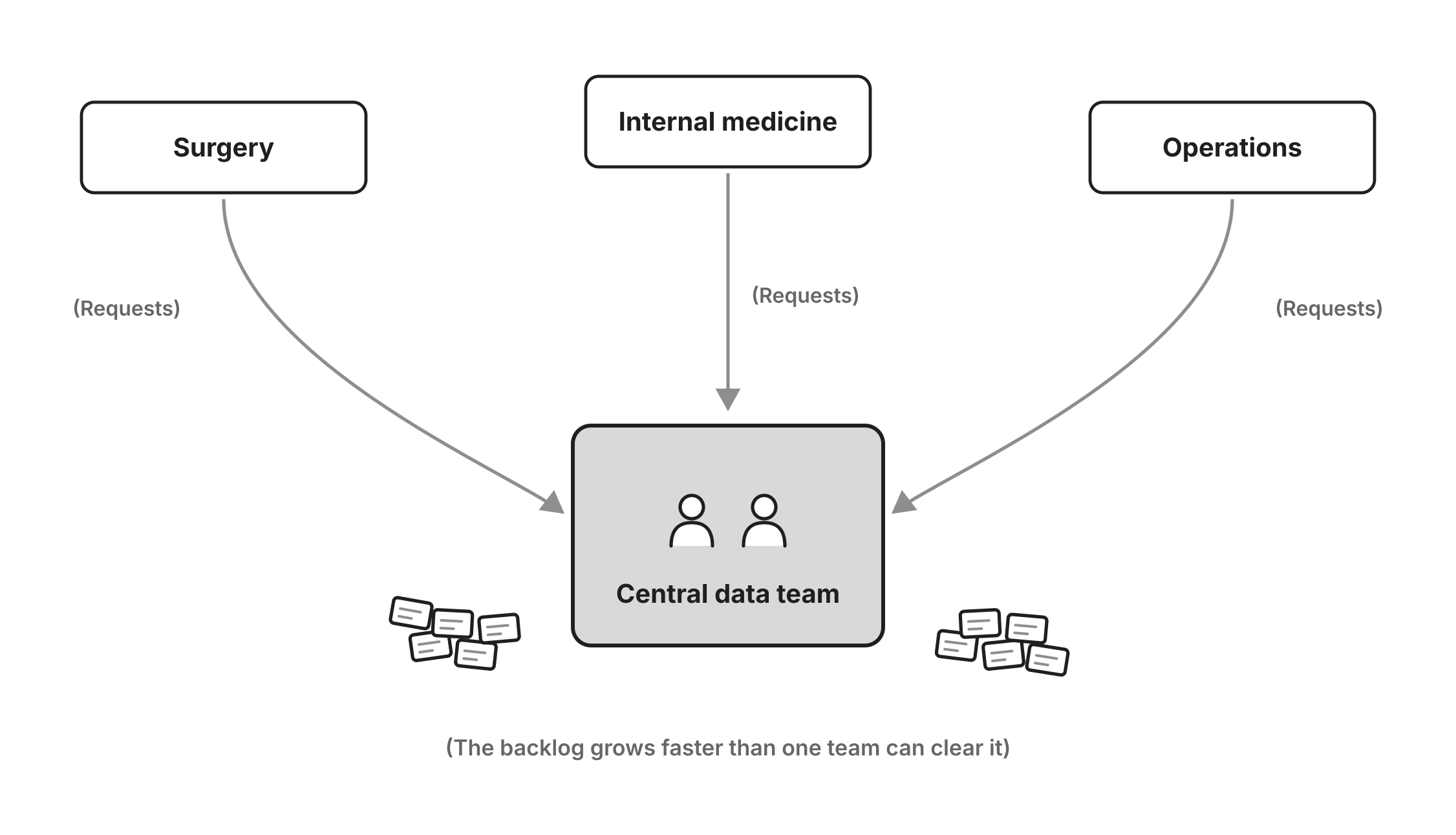
The data mesh says use a lake, use a warehouse, use whatever, but don’t have one central team doing all of it. Each department gets its own data team and its own data platform, or its own space on a shared one. Surgery has one. Internal medicine has one.
Instead of coordinating through one big data team, they coordinate through the data catalog. Each team works out what it needs, puts it in its platform, and publishes it to the catalog as a data product, so everybody can see it. A central data team, if there still is one, can use the catalog too, and go back to that platform to access the data.
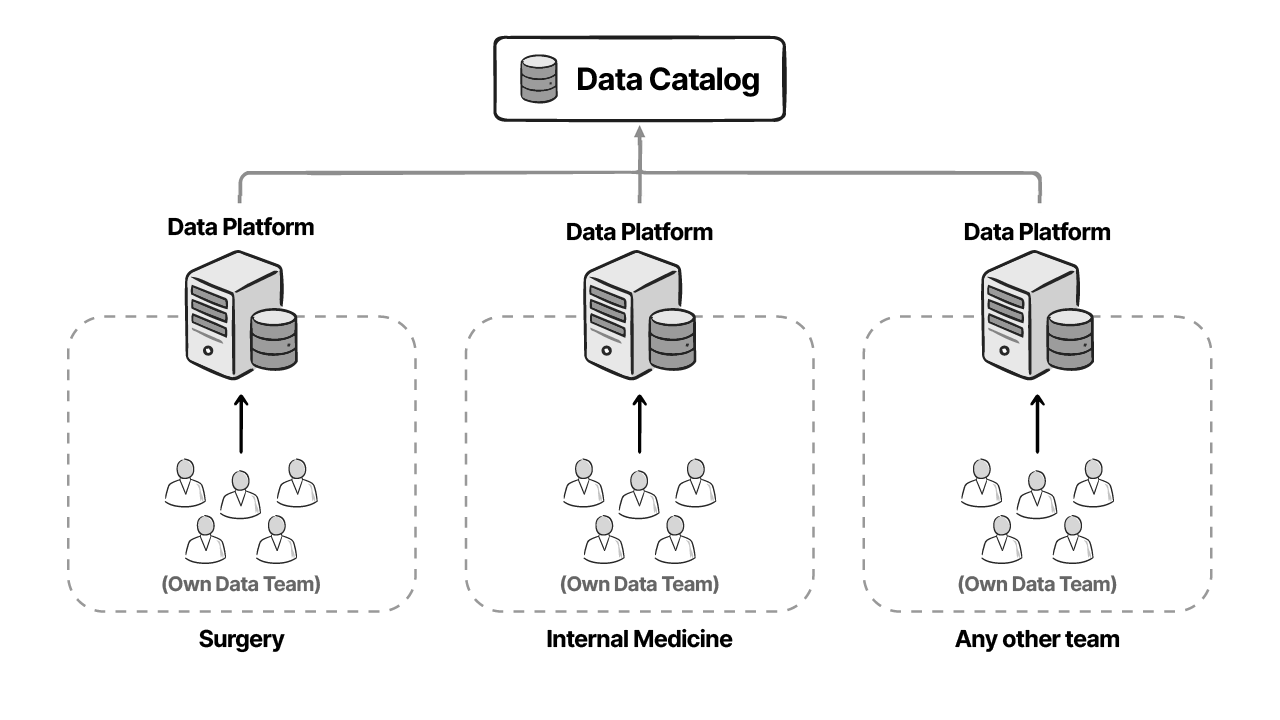
The idea comes from Zhamak Dehghani, who described the data mesh in a 2019 article.
If a single data team has become your bottleneck, splitting it up is the natural move. That works at the scale of Google or Amazon. Most healthcare organizations, even large ones, have a handful of people handling data, sometimes just two, as I mentioned at the start. A data mesh is a fix for a data team that has grown too big, and healthcare data teams don’t get that big.
If the data mesh sounds familiar, it’s because software went through the same thing with microservices. And I don’t think healthcare needs those in a lot of cases either.
Say you have multiple teams building one application on one database. They all need to coordinate their changes, and they all go through one database administrator. That person becomes the bottleneck for every change, making sure the database’s structure (its schema) is migrated properly, and that a change one team makes doesn’t break something another team uses.
That’s what pushed people toward microservices. Instead of one monolithic application on one database, you split it up. Each team gets its own application and its own database, and can deploy independently. It goes hand in hand with DevOps, where smaller teams handle their own dev and ops, with no dependency on a separate ops group.
The data mesh does the same thing for data, with departments instead of development teams. The change is in how teams are organized more than in the technology.
Does splitting things up like this make sense in healthcare? In my experience, no.
Look at Epic, one of the largest EHRs on the planet and one of the most complicated pieces of software we’ve seen. It still runs on a single operational database, InterSystems Caché (now IRIS), and they’re happy with it. They’ve figured out how to make their teams work together without a bunch of microservices.
When I see new healthcare startups planning one microservice for this and another for that, they’re just adding complexity to the architecture and more ways for it to break. Maybe an inter-service API call fails, or deploying the product now needs a full Kubernetes cluster. Most of that could be avoided with one monolith and one database. Martin Fowler has made the same case in Monolith First.
People think of the monolith as old technology, and assume microservices will just be better. But the problem microservices solved was really big teams not being able to deploy independently. AWS and Netflix probably have that problem, with so many teams working independently on what they’re in charge of. In healthcare, the software follows the hospital’s workflow, and there aren’t that many teams building it.
So I think microservices in healthcare are probably a mistake, and so is the data mesh. It’s going too far.
| Database (OLTP) | Data warehouse | Data lake | Data mesh | |
|---|---|---|---|---|
| Optimized for | Recording what happens | Analyzing data from many systems | Storing all data cheaply and analyzing it later | Letting each department run its own analytics |
| How data gets in | Written by the application | ETL | ELT | Each department’s own pipelines |
| Storage and compute | Together | Together in traditional warehouses, separated in cloud ones like Snowflake and BigQuery | Separated | Depends on each platform |
| Lineage | Not tracked | Reported by each ETL script | Derived from the transforms (with tools like dbt) | Shared through a data catalog |
| Who runs it | Application team | Central data team | Central data team | A data team per department |
| In healthcare | Analysts query the EHR, LIS or RIS database directly, still the most common approach | FHIR servers and openEHR CDRs used as warehouses, fed by scripts | EHR, lab and other data loaded to cloud storage as is, then transformed | Needs a data team in each department, more people than most healthcare organizations have |
For healthcare, stick with the data lake. It’s a good middle ground between a warehouse and a mesh.
Because storage and compute are separate, you only pay for compute when you use it, and it’s widely available on most public clouds. You can run it on-prem if you want, but then you lose those cost savings. It also gets you lineage, and you’re no longer rewriting ETL scripts every time a source system changes.
Then build a good data catalog. Give your teams what they need to work independently, and at least make sure they can discover which datasets exist.
And this is where AI comes in. Instead of having an analyst, you’ll have an AI, and literally everyone in your organization becomes an analyst. Any user can ask it a question. If you have a rich catalog and good quality data that you’ve already done the work on, you’ll be able to do far more than an organization that hasn’t.
If you’re trying to connect Epic, Salesforce or another system to a data lake, book a call with me and we can talk it through.
Healthcare interoperability keeps failing for the same two reasons: inconsistent data models and bad sync. Here's what solving both would actually take.
Why openEHR works better as a silver layer in your data warehouse than as a CDR, and what that means for clinical data at scale.
My mother-in-law needed a clinical trial. My wife and I, both doctors, had a hard time finding the right one. I decided to try to solve it.