USCDI Explained: Data Classes, Versions and FHIR Mapping
What USCDI requires, how its data classes map to US Core FHIR profiles, which version certification needs (v3), and what changed through USCDI v7.
November 13, 2026
TL;DR
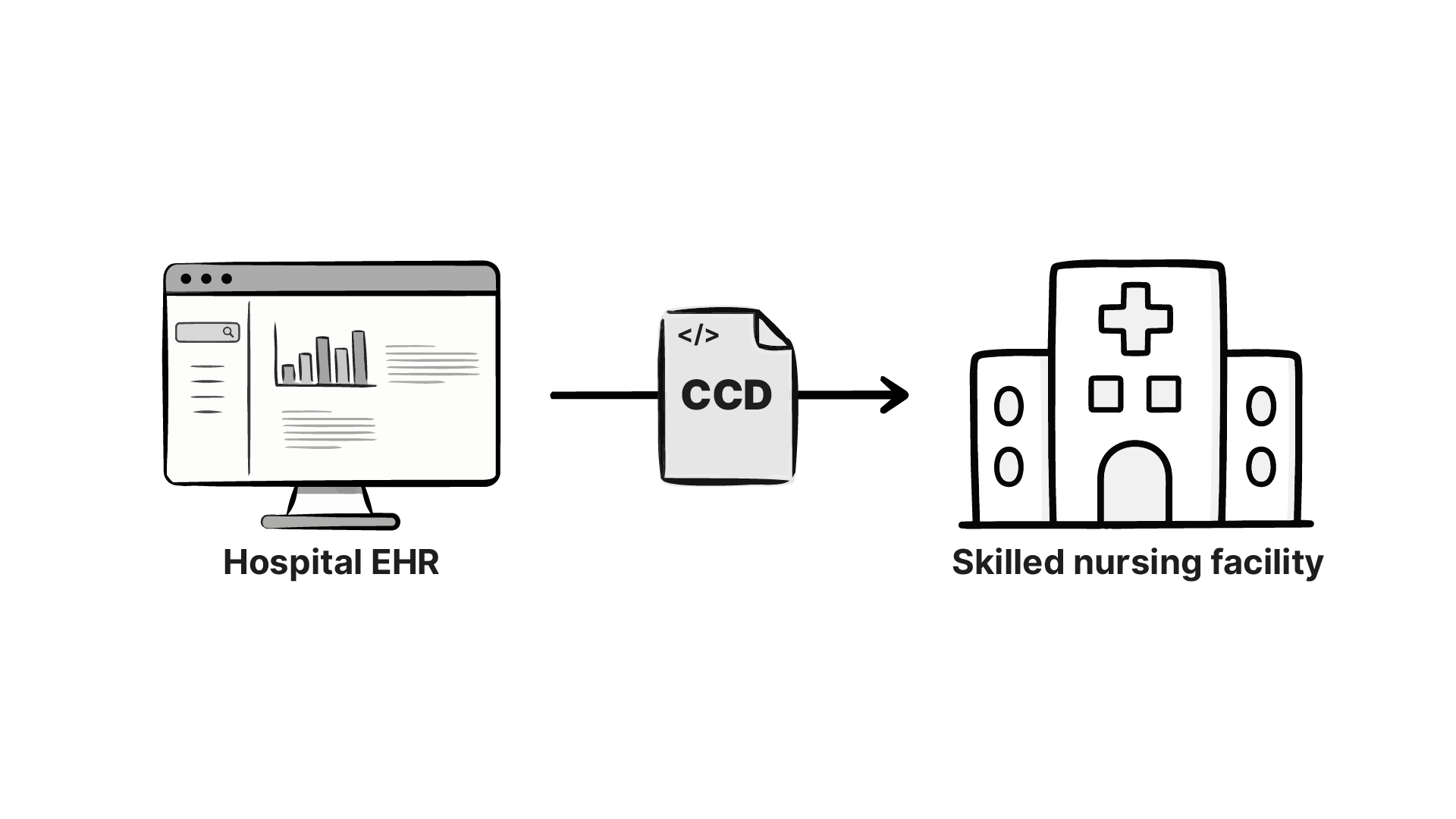
A patient is being discharged from hospital to a skilled nursing facility on a Friday afternoon. The nursing facility needs to know what she’s allergic to, which medications she’s leaving on, what was done during her stay, and what the hospital wants to happen next. Often, that information leaves the hospital’s EHR as a Continuity of Care Document, or CCD.
A CCD is an XML document built on HL7’s Clinical Document Architecture (CDA). HL7 describes it as a core data set of the most relevant administrative, demographic and clinical facts about a patient’s care, covering one or more encounters. It’s a summary, not the full chart. The receiving system can show it to a clinician as a readable document and, if the coded entries are good, import the medications, allergies and problems into its own record.
CCDs are a US standard. The template that defines them sits in Consolidated CDA (C-CDA), HL7’s US Realm library of CDA templates, and federal EHR certification has required C-CDA support since Meaningful Use Stage 2. That requirement now has an end date, which we cover in the FHIR section below.
As a developer, you’ll most likely run into a CCD when you pull records from a health information exchange, receive a referral, or get asked to “just import the CCD” into your product.
Every CCD has two parts: a header that says who and what the document is about, and a body made of clinical sections.
The header carries the patient’s demographics and identifiers, the author (a person or the system that generated it), the custodian organization responsible for the document, and the encounter or time period it covers. Demographics live here, not in a body section.
The body is where the clinical content sits. In the HL7 CCD profile, six sections are required:
Thirteen more are optional, including Procedures, Immunizations, Encounters, Plan of Treatment, Family History, Functional Status, Advance Directives, Goals and Health Concerns. That’s why two CCDs for the same patient from two EHRs can look very different. The required six will be there; the rest depends on what each vendor chose to populate.
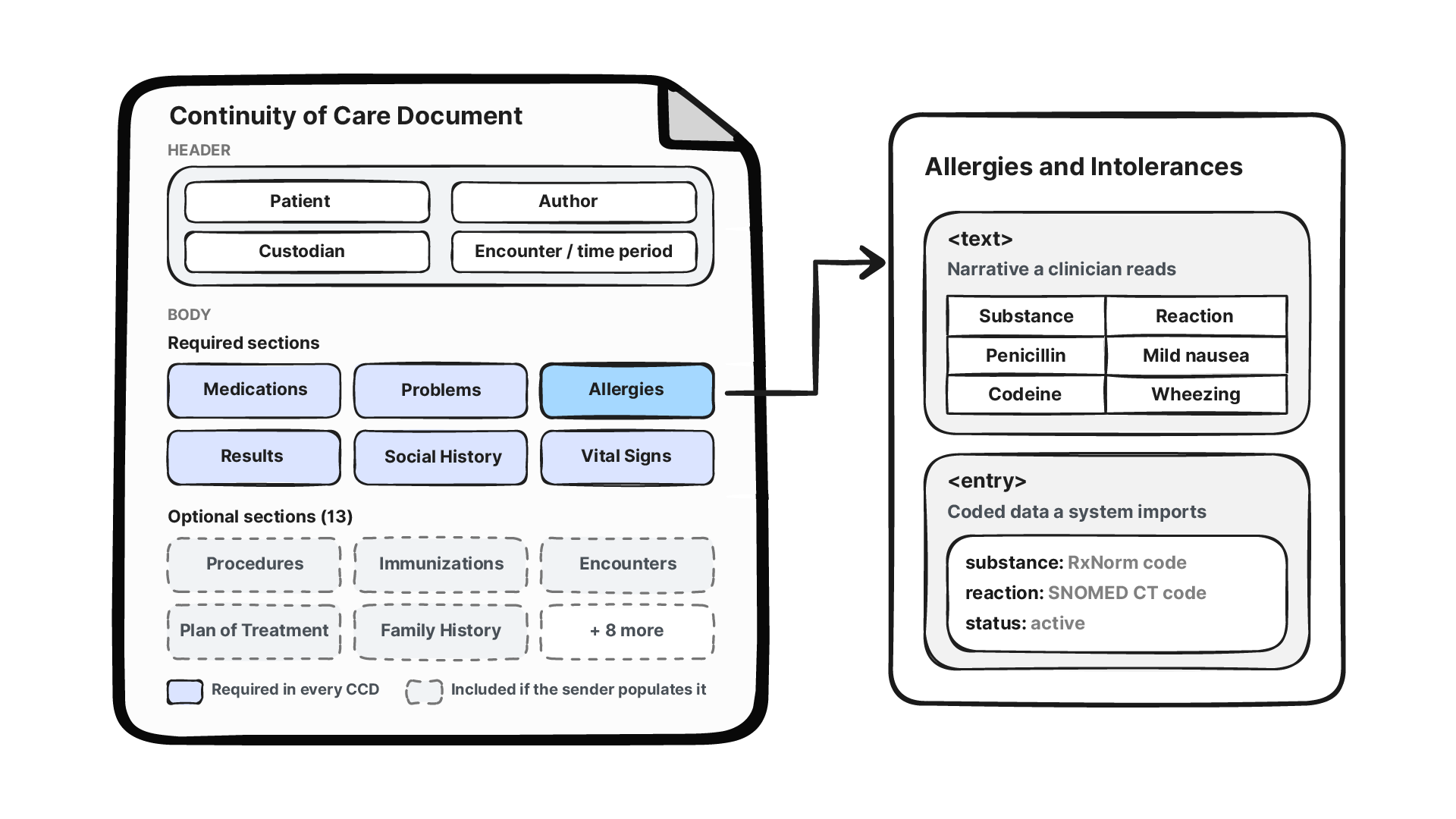
Each section carries the same information twice. The <text> block is the narrative a clinician reads, usually an HTML-like table. The <entry> elements hold the same facts as coded data a system can import: an RxNorm code for a medication, a SNOMED CT code for a problem, a LOINC code for a lab result.
CDA treats the narrative as the legal record. HL7’s guidance says the document originator is responsible for making sure the narrative block contains the complete, attested content of the section. So if the narrative and the coded entries disagree, the narrative is the attested record. An importer that only reads entries won’t notice.
Here’s a trimmed CCD showing the header templates, the document type code and one section:
<ClinicalDocument xmlns="urn:hl7-org:v3">
  <realmCode code="US"/>
  <typeId extension="POCD_HD000040" root="2.16.840.1.113883.1.3"/>
  <!-- CCD template ID: versioned, then unversioned for older receivers -->
  <templateId root="2.16.840.1.113883.10.20.22.1.2" extension="2015-08-01"/>
  <templateId root="2.16.840.1.113883.10.20.22.1.2"/>
  <code code="34133-9" displayName="Summarization of Episode Note"
        codeSystem="2.16.840.1.113883.6.1" codeSystemName="LOINC"/>
  <title>Patient Chart Summary</title>
  <recordTarget>
    <patientRole>...</patientRole>   <!-- the patient -->
  </recordTarget>
  <author>...</author>                <!-- who or what created it -->
  <custodian>...</custodian>          <!-- organization responsible for it -->
  <component>
    <structuredBody>
      <component>
        <section>
          <!-- Allergies and Intolerances Section (entries required) (V3) -->
          <templateId root="2.16.840.1.113883.10.20.22.2.6.1" extension="2015-08-01"/>
          <templateId root="2.16.840.1.113883.10.20.22.2.6.1"/>
          <code code="48765-2" codeSystem="2.16.840.1.113883.6.1" codeSystemName="LOINC"/>
          <title>ALLERGIES AND ADVERSE REACTIONS</title>
          <text>
            <table>...Penicillin | Mild Nausea...</table>  <!-- what a clinician reads -->
          </text>
          <entry typeCode="DRIV">                           <!-- derived from the narrative -->
            <act classCode="ACT" moodCode="EVN">...</act>  <!-- Allergy Concern Act: what a system imports -->
          </entry>
        </section>
      </component>
      <!-- Medications, Problems, Results, Social History, Vital Signs ... -->
    </structuredBody>
  </component>
</ClinicalDocument>
The templateId values are how a parser knows what it’s looking at. The document-level ID marks this as a CCD, and each section’s ID tells you which C-CDA template it follows and what rules apply to its entries. HL7’s sample sends each ID twice, once with a version date in extension and once without, so receivers built for older C-CDA releases still recognize it. The typeCode="DRIV" on the entry says the coded data is derived from the narrative above it. This snippet is trimmed from HL7’s C-CDA R2.1 sample CCD, which is a good complete file to test against.
These four acronyms get used interchangeably, but they sit at different levels. CDA is the document framework, CCR was the earlier summary format, CCD is one document type, and C-CDA is the template library that defines CCD and its siblings.
CDA is HL7’s Clinical Document Architecture. It defines the XML structure of a clinical document (header, body, sections, narrative, entries) but says little about what clinical content goes in. On its own, almost everything in CDA is optional.
CCR, the Continuity of Care Record, came from ASTM International as a summary format for passing a patient’s core data between providers. It’s also XML, but it isn’t built on CDA, and unlike CDA it has no free-text section that has to be rendered and authenticated.
CCD was HL7 and ASTM’s way of ending the split between the two camps. It takes the CCR content and expresses it as constraints on CDA Release 2, based on ASTM E2369-05. The first release came out in April 2007.
C-CDA, Consolidated CDA, came next. Stage 1 of Meaningful Use accepted either CCD or CCR for care summaries, and implementations drifted. For Stage 2, HL7 pulled the CCD and other common document types into one implementation guide, and CCR dropped out of the certification requirements. Today’s C-CDA is a library of CDA templates covering 11 document types, including CCD, Discharge Summary, Referral Note, Transfer Summary and Progress Note.
So a “C-CDA” and a “CCD” aren’t competing formats. A CCD is one kind of C-CDA document. For care transitions, ONC’s transitions of care criterion is scoped to three of them: the CCD, the Referral Note and, in inpatient settings, the Discharge Summary.
C-CDA is still versioned and maintained. C-CDA 5.0.0 (STU5) was published in June 2026 with guidance aligned to the current USCDI version, and ONC has approved it as an optional newer version for certified EHRs. The baseline for certification remains C-CDA R2.1 with the Companion Guide Release 4.1, which covers USCDI v3.
C-CDA defines what goes in the document, not how it travels. In practice, a CCD reaches another organization in one of three ways.
The first is a push over Direct, which is secure, SMTP-based messaging between known endpoints. When a hospital discharges a patient to a nursing facility or a primary care practice sends a referral, the EHR attaches a CCD to a Direct message addressed to the receiving provider. This is the path the ONC transitions of care criterion was built around.
The second is a pull through a network. Carequality, CommonWell and eHealth Exchange use IHE profiles, mainly Cross-Community Patient Discovery (XCPD) to find the patient and Cross-Community Access (XCA) to query and retrieve their documents. An emergency department seeing a new patient can query these networks and get back CCDs from connected organizations that have treated them. TEFCA started from the same base: its initial work built on IHE-based exchange of C-CDA content.
The third is the patient. Certified EHRs let patients view, download and transmit their records, and the download has to be available both in human-readable form and as a C-CDA file built on the CCD template.
For a developer, the network path is the one that shows up most. If your product pulls records through an HIE or a network aggregator, a good share of what comes back is CCDs and other C-CDA documents, often several per patient from different sources, overlapping and sometimes contradicting each other.
A CCD that passes validation can still be hard to use. C-CDA allows a lot of room in how a fact gets expressed, and every EHR fills that room differently.
This has been documented since C-CDA became mandatory. A 2014 study of certified EHRs found both errors and permitted variation that would limit how reliably software could read the documents. Common trouble spots included missing allergic reactions, missing dose frequency and missing result interpretation. HL7 has since folded lessons from cross-vendor testing and HIE document reviews back into the guide. A later VA-led review of C-CDA 2.1 certification samples from 52 EHRs found that while schema and schematron conformance had improved, issues affecting access to critical data and patient safety remained. Those samples are public on GitHub, which makes them a useful test set for your parser.
The ones you’ll hit first:
templateId extension tells your parser which rules apply.To check a document before you build around it, ONC’s C-CDA Scorecard scores a C-CDA file against the spec and best-practice rules and points to the sections that need work. It’s a quick way to see how much clean-up a given sender’s documents will need.
A CCD is a snapshot: one document, generated at one point in time, carrying a fixed set of sections. FHIR works at the level of individual resources. A FHIR API lets you ask for a patient’s current AllergyIntolerance or MedicationRequest resources directly, and get back exactly those. FHIR can also package resources as a document Bundle, but most FHIR integrations query resources rather than exchange documents.
That difference matters for what you build. With CCDs, you parse whole documents and work out what changed since the last one. With a FHIR API, you query the data you need when you need it.
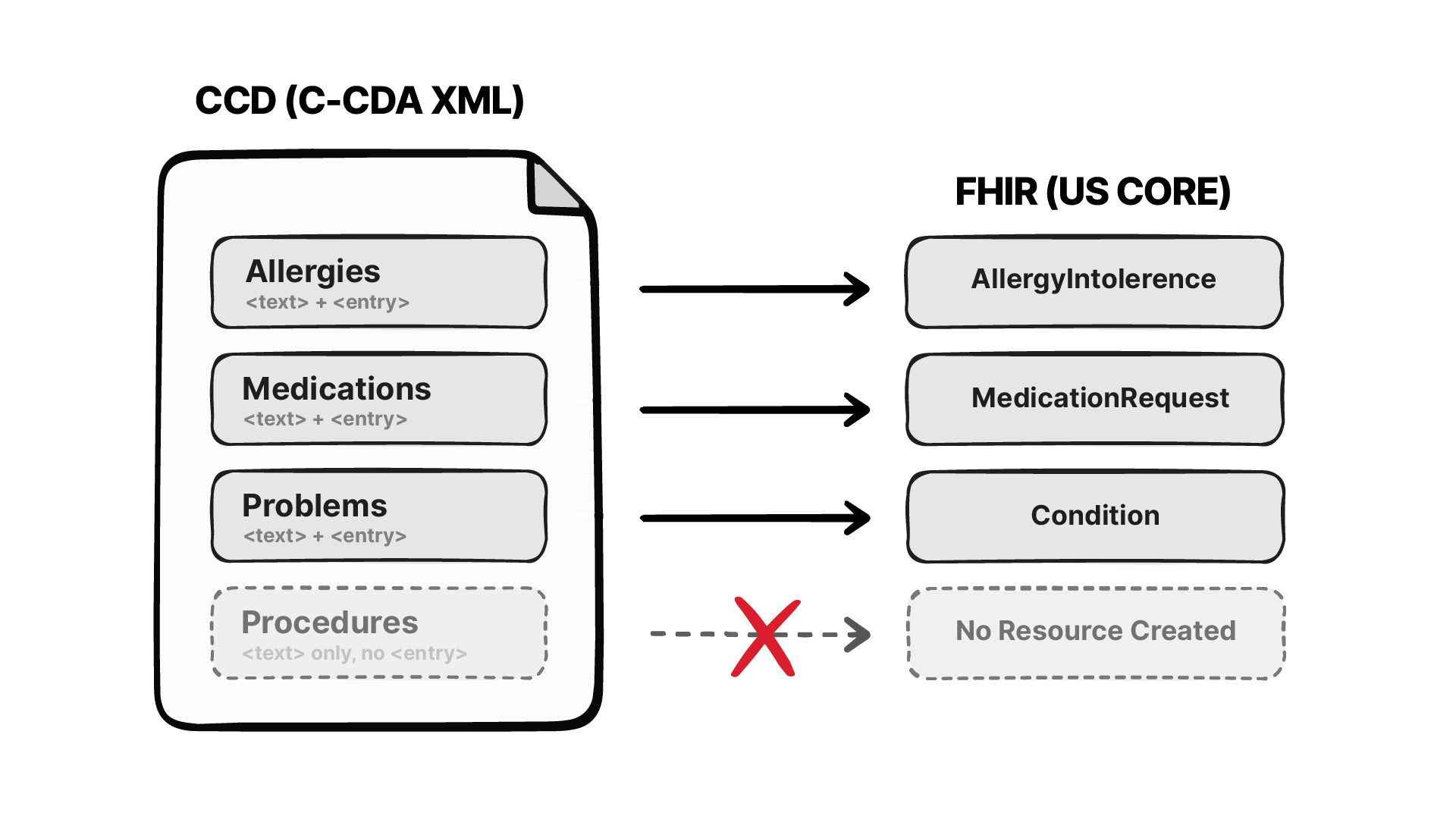
HL7 publishes the mapping. The C-CDA on FHIR implementation guide gives transformation guidance from C-CDA templates to US Core FHIR profiles, starting with problems, allergies, medications, procedures and immunizations and extending to more domains in the current release. A medications section entry becomes a MedicationRequest, an allergy entry becomes an AllergyIntolerance, and so on, with concept maps for status codes, severity and other value sets.
Two caveats from the guide itself. The C-CDA to FHIR direction was worked out with several vendors at Connectathons, but the FHIR to C-CDA direction has only been piloted by one company. And HL7 says plainly that automated transform is possible in constrained use cases but is not lossless, because the two standards differ in flexibility and expressiveness. Everything in the “Where CCDs break” section above comes along for the ride: a narrative-only section gives you no resources, and a local code stays a local code.
In practice, a CCD-to-FHIR pipeline ingests the document, validates it, maps entries to US Core resources, normalizes codes where it can, and deduplicates against what’s already stored for that patient. Deduplication needs its own design. HIE networks exchange multiple CCDs for the same patient from different sources, and without it, clinicians end up reviewing long, redundant information spread across documents. In one HIE pilot, automated deduplication caught 99.1% of duplicate problems but only 87.0% of allergies, and almost every miss came from inconsistent use of standard terminologies.
On October 26, 2026, ONC released the HTI-5 final rule. For CCDs, three things stand out:
So certified EHRs must keep producing CCDs for care transitions until 2030, and the federal direction after that is FHIR. The documents won’t vanish on that date either. Senders without FHIR-based transitions in place, archives, and network queries will keep returning CCDs well after it, which is why reading them reliably and mapping them to FHIR is the practical skill to have now.
templateId values as your parser’s entry point. They tell you it’s a CCD, which C-CDA version it follows, and which rules apply to each section.If you’re working out how to get CCDs, FHIR data or both into your product, Medblocks’ development teams build EHR and standards-based integrations across Epic, Cerner, Athena, eClinicalWorks and more. Book a free 30-minute call to talk through your setup.
A CCD is a US patient summary in XML, built on HL7 Clinical Document Architecture (CDA). It carries the most relevant administrative, demographic and clinical facts about a patient's care, such as allergies, medications, problems and results, so another provider can continue treatment.
Six sections are required: Allergies and Intolerances, Medications, Problems, Results, Social History and Vital Signs. Thirteen more are optional, including Procedures, Immunizations, Encounters and Plan of Treatment.
C-CDA (Consolidated CDA) is HL7's library of CDA templates for 11 US document types. A CCD is one of those document types. When people ask for a C-CDA for a care transition, they usually mean a CCD.
No. A CCD is a summary covering one or more encounters, not the full chart. It holds the information a receiving provider most needs to continue care.
CCDs are pushed between providers over Direct secure messaging, pulled through national networks such as Carequality, CommonWell and eHealth Exchange using IHE profiles, or downloaded by patients from their provider's portal.
Yes. HL7's C-CDA on FHIR implementation guide maps C-CDA entries to US Core FHIR resources, such as allergy entries to AllergyIntolerance. HL7 notes the conversion is not lossless, and sections with no coded entries produce no resources.
Under ONC's HTI-5 final rule, the C-CDA and Direct requirements in the transitions of care certification criterion end on January 1, 2030. Certified EHRs must support CCDs until then, and existing documents and network queries will keep returning them after that date.
What USCDI requires, how its data classes map to US Core FHIR profiles, which version certification needs (v3), and what changed through USCDI v7.
What clinical decision support tools exist, how they work in Epic, Oracle Health and OpenEMR, why alert fatigue happens, and how to build CDS with CDS Hooks, FHIR and CQL.
How Epic EHR works under the hood: the MUMPS database, free FHIR APIs, integration paths, implementation costs, and why production access depends on a hospital.