Why Epic Integration Matters
If you’re building software for healthcare, one thing decides whether it gets used: can it plug into the systems hospitals already run on?
Your product can be excellent and still go nowhere if it can’t become part of the daily workflows of doctors and nurses. A competitor with a weaker product will win the account if their app connects and yours doesn’t.
So for most healthcare software, integration decides whether you get business at all.
Here’s the catch: healthcare is one of the hardest industries to integrate with. The systems were built to keep you out and gatekeep the data. Some of that is patient privacy and the rules around it, and some of it is that no one had much reason to make it easy. So how do you integrate?
In the US, the answer almost always starts with Epic. A huge share of patient records live inside Epic systems. Epic runs more than 40% of US hospitals and over half of all hospital beds. So if you’re building healthcare software in the US, integrating with Epic really matters.
One honest caveat. This is a US story, and it’s strongest at the top. The big academic centers and health systems lean Epic, which is why the bed share runs ahead of the hospital share. Smaller clinics and outpatient practices are far more mixed. But if you’re aiming at large hospitals, you’re aiming at Epic.

Build your first real FHIR app in 15 days
500+ builders have done it. Live kick-off, structured modules, Demo Day. $27.
Join the challengeWhat this course covers
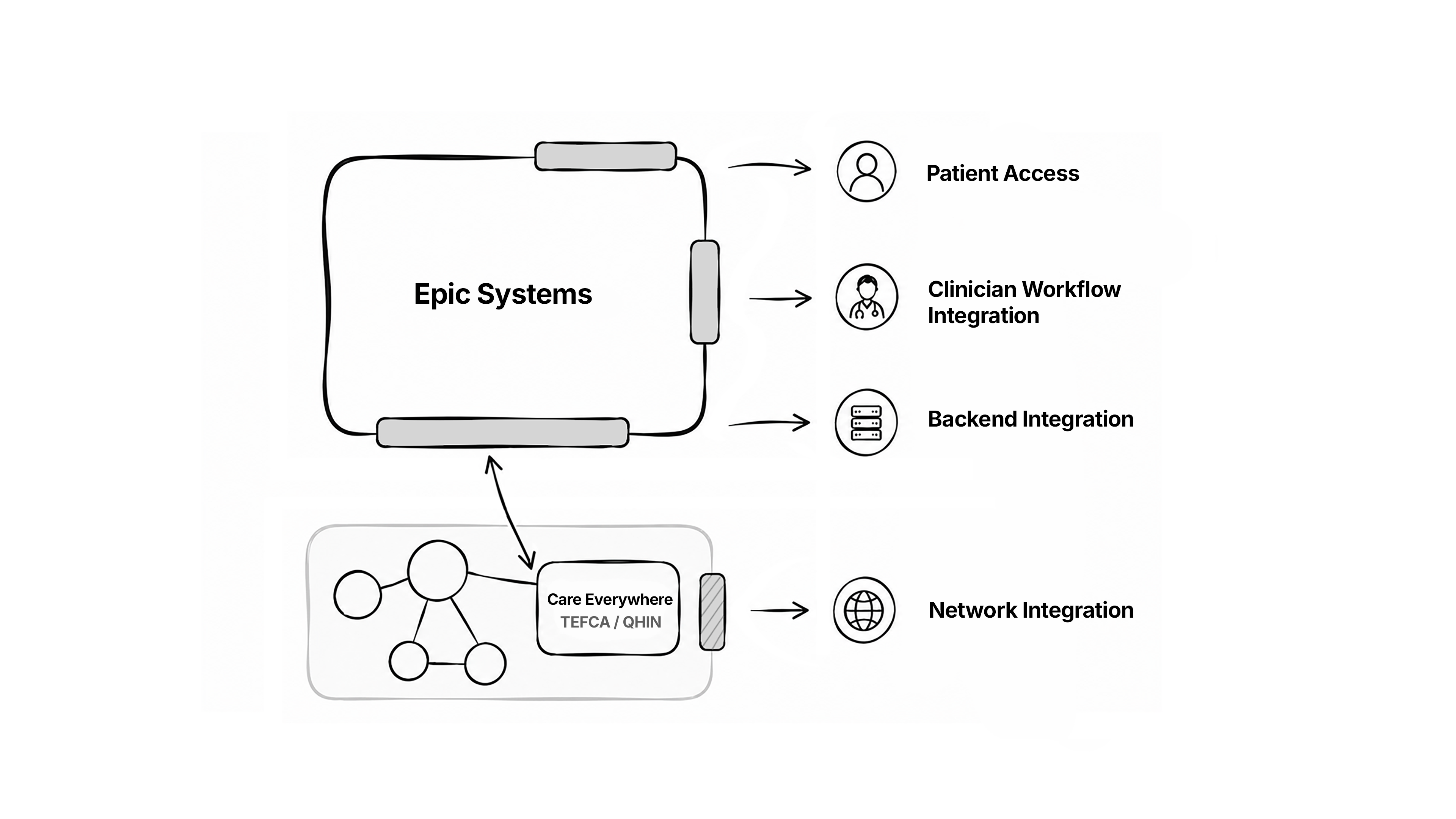
We start with the basics: what Epic is, and the ways your software is allowed to talk to it. Then we look at the ways you can connect to Epic: patient-facing apps, workflows doctors use inside the hospital, backend systems that talk to each other directly with nobody in the loop, and more. We go through each one, and you’ll see how it works.
We’ll also look at what it costs, how long it takes, and where things get stuck. You’ll know what to expect before you start.
Who it’s for
Two kinds of people: developers who need something to work with Epic, and founders or product managers deciding whether to take it on at all. We’ve got both: hands-on Epic integration for developers, and a high-level picture of what Epic integration actually takes for everyone else.
What you should already know
This course is about integrating with Epic, so we assume you’ve got the basics down. You should be comfortable with REST APIs and JSON, and ideally you’ve seen FHIR and SMART on FHIR before, since that’s the language most Epic integration is built on.
If those terms mean nothing to you, don’t start here. We have a free FHIR Fundamentals course that will get you up to speed. Go through it first, then come back, and this will make a lot more sense.

If you’re here on the decision-making side, you don’t need to go deep. A quick skim will do.
Setup
We suggest everyone should do this part, whether or not you write code.
First, an Epic developer account. Go to fhir.epic.com and sign up. It gives you a sandbox, a safe environment with fake test data, so you can build without touching anything real. It can take a few days to come through, so do it now and let it process in the background. When you sign up, there’s an agreement you’ll have to accept to use Epic’s APIs. That’s normal, and we’ll get into it later.
Next, your tools. A code editor like VS Code or Cursor, an API client like Postman or curl (already on most machines), and Node.js which we’ll use to build with.
Node runs the tooling we’ll use to build the app. We’ll write the frontend in React, and in the final module we’ll add a backend with Express, which also runs on Node.
One thing we’re not doing yet: registering your app in Epic. That starts in the next module, when we build for real. For now, just get your account and tools ready. Don’t register anything yet.
That’s it, you’re set for the next lesson.