Clinical Scenario: Recording Diagnosis and Ordering Services
Now that the patient’s story, context and vital signs have been captured, what’s next?
The patient describes their symptoms, mentioning that they have been experiencing persistent headaches and frequent urination. These details would be captured in the Signs/Symptoms cluster within the Story/History archetype.
Taken together with the history and measurements already captured, the clinician suspects diabetes. At this stage, the doctor is not making a final diagnosis, but it is a working clinical impression that needs to be recorded.
Build your first real FHIR app in 15 days
500+ builders have done it. Live kick-off, structured modules, Demo Day. $27.
Join the challengeRecording a suspected diagnosis
Archetypes do not represent answers, they represent questions. So instead of searching for CKM for “diabetes”, we should ask:
What kind of clinical information is this?
Here, the doctor is expressing a clinical judgement. That immediately tells us we are working with an EVALUATION archetype.
If we search the CKM for “diagnosis”, we see a few related options:
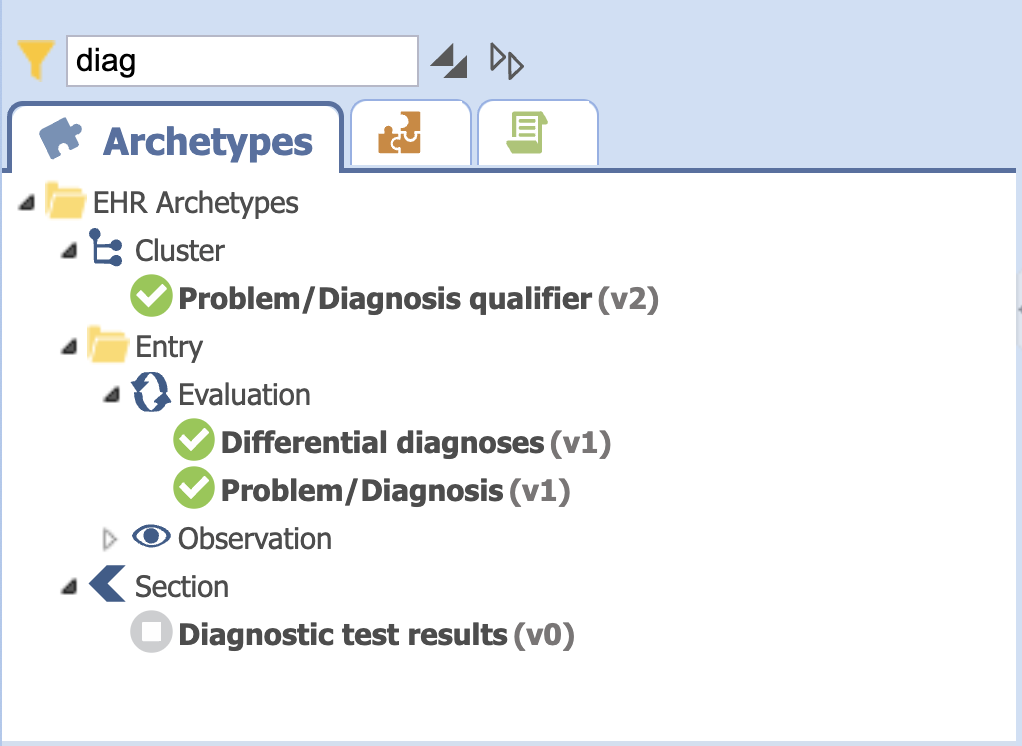
These archetypes represent slightly different types of information. A differential diagnosis is used as a way to record multiple diagnostic possibilities. The Problem/Diagnosis archetype is a good fit, as it can be used when the clinician has a strong suspicion but is waiting for confirmation.
Once added to the template, the doctor can:
- Record the diagnosis concept
- Indicate diagnostic certainty This is aligned with an EVALUATION, reflecting clinical judgement than direct measurement.
Ordering further investigations
The doctor can then decide to order lab tests to confirm. So, we ask the same question again:
What kind of clinical information is this?
Placing an order for a lab test instructs someone else to perform an activity. Hence, this is an INSTRUCTION.
Searching the CKM for “lab order” may not immediately give a clear answer. When that happens, it helps to browse archetypes by ENTRY type.
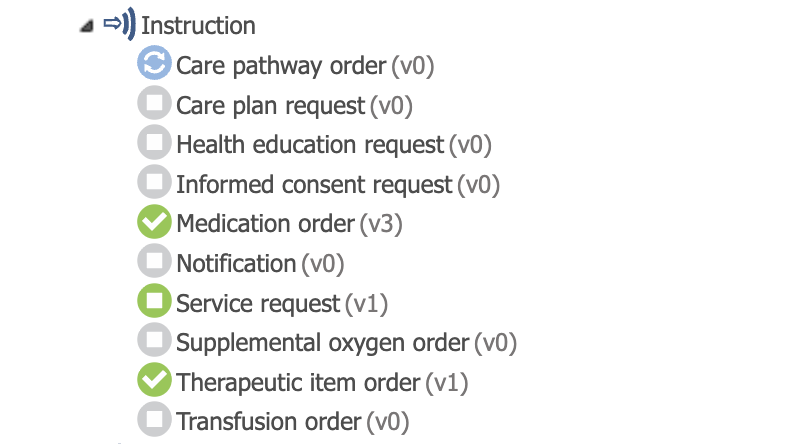
Under INSTRUCTION, one archetype stands out:
This archetype is used to record a request for a health-related service to be delivered by another clinician, organization, or agency. This is a good fit for ordering lab investigations. Using this archetype, the doctor can specify the type of service, describe what needs to be done, and optionally code the request using local or standard terminologies.
INSTRUCTION vs ACTION
It’s worth briefly reinforcing the distinction here:
- INSTRUCTION records what needs to be done
- ACTION records what was actually done
Ordering a lab test or prescribing medication is an INSTRUCTION. If some medication was administered during the appointment, it would be an ACTION.
Prescribing medication
The doctor may also prescribe medication during the same visit, for example, to manage symptoms like headache.
This would be recorded as an INSTRUCTION, using the Medication Order (v3) archetype.
Lesson summary
At this point in the workflow the template also captures a suspected diagnosis (EVALUATION) and a request for further investigation to confirm it (INSTRUCTION).
This mirrors real clinical practice followed by clinicians, listening to the patient, forming an impression and then ordering tests to validate it.